Platform
Every step between an order and a paid claim.
LABDATA 360° is a single platform, not a stack of point tools held together by spreadsheets. Below is the detail on the problems we solve, the safeguards we put at the keyboard, and the capabilities that turn processed specimens into paid ones.
Built on standards labs already trust
- HIPAA-aligned
- US-based team, US-hosted data
- Sign in with Microsoft, Google, Apple
- MFA / AAL2
- HL7 and API integrations
- Encrypted in transit & at rest
- Change-audited
What we actually solve
Built to kill the four most expensive problems in specialty-lab billing.
Every capability in LABDATA 360° exists because it fixes a specific, recurring failure mode we see at toxicology, molecular, reference, and pathology labs. These are the four we hear most.
Dirty intake data
Orders that cannot convert to clean claims.
Missing ZIPs, apartment numbers that do not exist, and patient names that do not match the member ID all get caught downstream, weeks later, by a biller. Correctness costs one person one minute at intake. The same error costs another team, repeatedly, after the specimen is gone.
How we solve it
- Address autocomplete backed by Google Places, with clinic-as-patient-address flags
- Duplicate-patient detection before the record is saved
- Insurance card capture, front and back, attached to the patient
- Name aliases let clinics pick familiar payer names while billing gets the identifiers claims require
Unverified insurance
The denial was decided before the sample was drawn.
Insurance verification is the constraint in a specialty lab's revenue cycle. Every demographic defect that matters shows up there. LABDATA 360° works that constraint directly: coverage is discovered and verified before the claim, by lab staff, at the moment it is practical rather than the earliest moment it is possible.
How we solve it
- Coverage discovery through Stedi from name, date of birth, and ZIP, even with no card on file
- Medicare eligibility checks against CMS using the MBI on file
- Every match is a proposal a billing team member approves; nothing auto-overwrites a record
- Self-learning payer mapping: link a plan once and the next patient matches automatically
Fragmented patient identity
One patient. One record. Across every organization you serve.
Duplicate patient records split clinical history, land results in the wrong chart, inflate patient counts, and create billing errors that are expensive to unwind. LABDATA 360° finds duplicates the day they are created, not the year you discover them.
How we solve it
- Exact (SSN), high-confidence (name + DOB), and medium-confidence (name + phone) matching
- Audited deactivate, archive, or delete resolution for lab staff
- Row-level hints that surface the safer record to keep
- Full audit trail on every resolution
Vendor sprawl
The stack you were paying several vendors to almost integrate.
The typical specialty lab runs separate tools for the order portal, eligibility, results delivery, supply requests, courier pickups, and client invoicing. Every seam between them is a place information falls on the floor, and every vendor adds contract, integration, and HIPAA audit surface area.
How we solve it
- Order entry, HL7 interfaces, insurance, results, and client invoicing in one login
- Supply orders, specimen pickups, testing schedules, and real-time chat in the same login
- Card payment through Stripe on client invoices, with paper and check as the fallback
- Built for toxicology, molecular, reference, and pathology from the first commit
What you get
Six pillars. One platform.
Everything a specialty lab needs to take an order, validate it, verify the coverage, send it, return results, keep customers supplied, and get paid, without taping together a handful of vendors.
Sign-in & Access
The account they already have. The access you decide.
Clinic staff sign in with Microsoft 365, Google, or Apple, so there is no new credential to forget and no reset ticket to chase. Every user is invited by an administrator; there is no public sign-up. Administrators, clinical users, and billing users each see only what their role and access groups allow.
- Sign in with Microsoft 365, Google, or Apple
- Password sign-in requires MFA, enforced by database policy on sensitive tables
- Invitation-only accounts; billing users never see lab results
- Access groups and organizational hierarchy for multi-site customers
Order Entry & Intake Safeguards
Order-to-lab in minutes, with the denial caught at the keyboard.
A guided intake flow validates dates, providers, insurance, and specimen-to-test compatibility before an order ever leaves the organization. The Order Feed gives lab staff one queue to monitor, flag, and triage everything across every customer in real time.
- Wrong-year detection and date-range checks
- NPPES lookup, daily PECOS sync, daily OIG exclusion screening
- Duplicate-analyte prevention at selection
- DYMO specimen labels with QR and barcode, chain-of-custody capture
Insurance & Eligibility
Verified before the claim. Passed through at cost.
Coverage discovery and Medicare eligibility run through our Stedi partnership. Lab billing staff work one queue: pending, lab assistance, self-pay recovery, re-verification, and discovery results. Organizations select insurance by the names they know; billing gets the payer identifiers claims require.
- Coverage discovery from demographics, no card required
- Medicare eligibility against CMS with the MBI on file
- Coordination-of-benefits roles for patients with more than one plan
- Verified coverage re-checked annually; Stedi fees passed through with no markup
Results Delivery
PDFs, flags, and abnormal-only views, ready the moment results drop.
Results stream in from your LIS over HL7, are matched to orders, and surface as PDF reports with abnormal and critical flags. Organizations get focused abnormal-only views; clinicians see the full report. Email notifications tell the right people when something new has landed.
- HL7 v2.3 ORU ingestion polled every five minutes
- Abnormal and critical filters, unread tracking, bulk PDF download
- Result retraction with reason codes and a permanent audit record
- Turnaround-time and abnormal-result reporting for the laboratory
Supplies, Pickups & Schedules
Everything else a customer calls the lab about, without the call.
Customers order collection supplies, set up recurring supply schedules, request specimen pickups, and run randomized testing programs from the same login. The laboratory sees supply burn against testing volume, so over-shipping and stock-outs are visible before they happen.
- Supply orders with recurring schedules and hold-and-ask exceptions
- Specimen pickup requests and recurring pickup schedules
- Randomized testing schedules with SMS reminders and an IVR line
- Supply Insights: burn rate versus vessels shipped, per customer
Sales & Field Team
Account managers and collectors work their accounts, not a spreadsheet.
Account managers see the organizations they own, collectors see the sites they serve, and managers inherit their team's view automatically. The Revenue Watchlist tells each account manager which accounts have unverified insurance, over-frequency testing, or pending ABNs, so one visit to an office manager clears every patient at that account.
- Revenue Watchlist: unverified insurance, over-frequency, self-pay, credentials, ABNs, disputes
- Account productivity: activation clocks, lost accounts, rep yield, top customers
- Sales and collection hierarchies with automatic access inheritance
- Trunk stock transfers so supplies handed over in the field are on the ledger
Intake safeguards, with examples
Eight rework loops that never start.
Each of these is a real failure mode we have watched turn into a denial, a patient statement to the wrong person, or a re-billed specimen. Here is what happens without the safeguard, and what LABDATA 360° does instead.
Address autocomplete
What happens without it: A clerk types the clinic's own street address into the patient record because the patient is homeless or in a hurry.
What LABDATA 360° does: Addresses come from Google Places, so the ZIP and apartment number are real. A patient address that matches the clinic is flagged for the laboratory before verification.
Duplicate-patient detection
What happens without it: The same patient is registered twice, once as Jon and once as Jonathan, under two different clinics.
What LABDATA 360° does: Matches on SSN, name plus date of birth, and name plus phone are shown before the record is saved. Lab staff resolve the rest from a duplicate-patients report with a full audit trail.
Guardian capture for minors
What happens without it: A 16-year-old is registered with no guardian, and the claim goes out with the minor listed as the subscriber.
What LABDATA 360° does: Guardian details are required when the patient is a minor, because the guardian is almost always the insurance subscriber.
Wrong-year dates
What happens without it: In the first week of January, a collection date is typed with last year's year.
What LABDATA 360° does: Implausible collection dates are stopped at entry instead of surfacing as a timely-filing problem months later.
Provider credentials
What happens without it: An ordering provider has fallen out of PECOS enrollment, or appears on the OIG exclusion list.
What LABDATA 360° does: NPIs are verified against NPPES. PECOS enrollment and OIG exclusions sync from CMS daily and are shown on the provider before an order is placed.
Duplicate analytes
What happens without it: Two panels that both contain the same analyte are selected on one order.
What LABDATA 360° does: Overlapping tests cannot be combined at selection, so the laboratory never runs and bills the same analyte twice.
ABN at the point of order
What happens without it: A Medicare patient is tested at a frequency the coverage policy does not support, and nobody signed an ABN.
What LABDATA 360° does: The CMS-R-131 form is generated and e-signed in the ordering flow when it is needed. Unsigned ABNs expire automatically instead of lingering.
Self-pay is verified, not asserted
What happens without it: A clinic marks a patient self-pay to skip the insurance fields, and a covered patient gets a statement.
What LABDATA 360° does: Self-pay is a state the laboratory confirms. A diagnosis code is required on every order, including self-pay, so nothing downstream has to follow the order blindly.
Eligibility through Stedi
Verified before the claim. At cost.
Coverage discovery finds active coverage from name, date of birth, and ZIP, even when the patient brought no card. Medicare eligibility checks run against CMS with the MBI on file. Every result is a proposed change a billing team member approves, so a record is never overwritten on a guess. We pass Stedi's transaction fees through with no markup, and we verify at the moment it is practical, not the earliest moment it is possible, so you are not paying for checks on patients who never show up.
- Discovery from demographics; Medicare eligibility with the MBI on file
- Payer results linked to your insurance directory once, then matched automatically
- Coordination-of-benefits roles when a patient has more than one plan
- One queue for lab billing: pending, lab assistance, self-pay recovery, re-verify, discovery
Order entry & QC
One queue. Every order. Caught before it costs you.
The Order Feed gives lab staff a single, real-time view of every order across every customer. Wrong-year dates, missing PECOS enrollment, excluded providers, duplicate analytes, and unverified insurance get caught at intake, long before lab work begins or a claim is denied. Once an order has been transmitted to your LIS it is locked; failed transmissions can be corrected and resent.
- Wrong-year detection and date-range guardrails
- NPPES lookup, daily PECOS sync, daily OIG exclusion screening
- Duplicate-analyte prevention at test selection
- Lab-wide flagging with notes for proactive follow-up
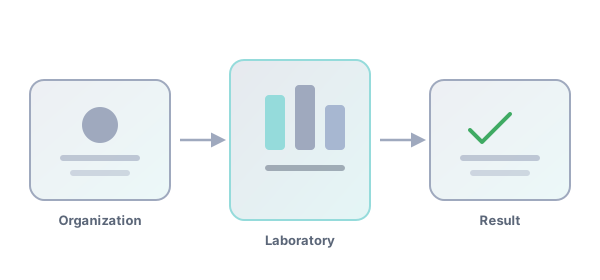
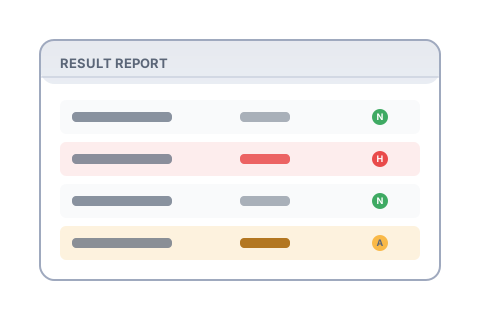
Results delivery
Results that arrive ready to act on.
Inbound HL7 ORU messages stream from your LIS into LABDATA 360° every few minutes, are matched to orders, and surface as PDF reports with abnormal and critical flags. Organizations get focused abnormal-only views; clinicians always see the full report. When a result must be withdrawn, retraction leaves a permanent record instead of a silent edit.
- HL7 v2.3 ORU ingestion polled every five minutes
- Abnormal and critical filters, unread tracking, bulk PDF download
- Result email notifications to the right people at each organization
- Retraction with reason codes and a permanent audit record
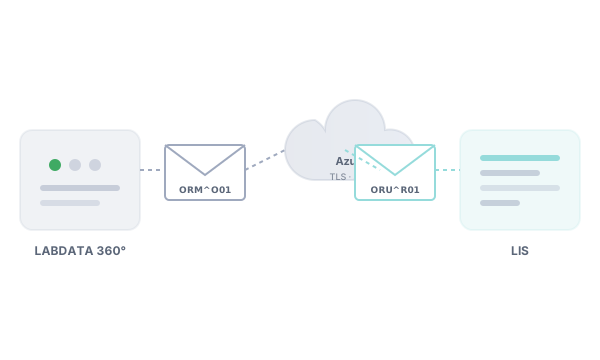
Interoperability
We speak whatever your LIS and your partners speak.
Your LIS speaks HL7 v2.x. Your payers and partners speak APIs. LABDATA 360° does both. Orders and results travel to the LIS as HL7 v2.3, proven at production volume with a national toxicology laboratory, over encrypted private cloud storage with retries and a per-message audit record. Eligibility, payments, addresses, messaging, and provider data run through partner APIs. When a partner offers an API, we use the API; when the LIS accepts HL7, we send HL7.
- HL7 v2.3 ORM out, ORU in, ADT in, to the LIS you run today
- API integrations for eligibility, payment, addresses, SMS, and CMS provider data
- 9 PM local batch, immediate Send Now for priority orders, per-message audit
- FHIR or a partner's own API built per customer when they offer one
AI where it earns its keep
Two AI capabilities that remove work instead of adding a review step.
The RCM industry built itself around writing appeal letters after a denial. We generate the medical necessity justification before submission, and we let clinic staff find the right test by what they mean rather than what the catalog calls it. JustifAI and AI Test Search are opt-in, never blocking, and never the only path to the goal.
- Lab test CERT improper-payment error rate
27.2%
Lab test CERT improper-payment error rate
- Annual lab share of Medicare Part B improper payments
$1.2B
Annual lab share of Medicare Part B improper payments
- of CERT lab errors trace to documentation, not coding
80%+
of CERT lab errors trace to documentation, not coding
- Industry-wide annual spend on denial rework (CAQH)
$8.6B
Industry-wide annual spend on denial rework (CAQH)
JustifAI
Medical necessity, written as the order is placed.
The leading cause of lab denials is insufficient medical necessity documentation, not incorrect coding. Medicare coverage policies prohibit boilerplate and require individualized justification for every test, on every date, for every patient. JustifAI generates that narrative at the Review & Submit step from the patient's diagnoses, medications, prior abnormal results, and testing history.
How it works
- Runs at Review & Submit on insurance-billed orders
- Pulls diagnoses, medications, prior abnormal results, testing history
- Individualized narrative tailored to the specific encounter
- Stored PDF with document ID, timestamp, and model version for audit
- Provider opt-in, organization opt-in, never blocking
AI Test Search
Search for what you mean, not what the catalog calls it.
Semantic search over the test catalog and the workspace understands synonyms, drug classes, and clinical intent. Clinic staff type "opioid" and get the right panels back even if the catalog calls them analgesics. The same search, opened with a keyboard shortcut, jumps to any patient, order, or result.
How it works
- Semantic matching across synonyms and drug classes
- Drug-class filter chips for fast narrowing
- Catalog stays in your laboratory's terminology, no tagging burden
- Global search across patients, orders, and results from any page
Sources: CMS CERT 2024 report, CAQH Index. Prior authorization tracking with AI-drafted justification is also available for laboratories whose payers require it.
Not one size fits all
The core gets you paid on every specimen. The rest we build with you.
Every laboratory has a customer that needs something nobody else does. LABDATA 360° ships a core that already covers the work between an order and a paid claim, and a team that adds what your next customer needs, in your terminology, on your timeline.
In the core today
- Sign in with Microsoft 365, Google, or Apple
- Guided order entry with intake safeguards
- Coverage discovery and Medicare eligibility through Stedi
- HL7 v2.3 to your LIS, API integrations everywhere a partner offers one
- Results with abnormal flags, PDFs, and email notifications
- Supply orders, recurring schedules, and specimen pickups
- Randomized testing programs with SMS and IVR
- Client invoicing with card payment through Stripe
- Revenue Watchlist and field-team reporting
- Real-time chat between customers and the laboratory
What we will build with your next customer
- FHIR interfaces for a customer's EHR or a payer's prior-authorization API
- Pharmacogenomics (PGx) panels, reporting, and result formats
- Additional inbound patient feeds from a customer's EHR
- Courier and shipping integrations beyond FedEx
- Payer-specific rules, forms, and documentation requirements
- Reports your billing or sales team needs and does not have today
Scoped and priced per engagement. We tell you what is in the core and what is new work, and we do not sell a roadmap as a feature.
See LABDATA 360° on a real workflow.
Tell us a little about your laboratory and we’ll provision a guided demo. No credit card, no contract, just a 30-minute working session with our team.